Thursday, 1 August 2013

The Plantswomen’s Garden

When you imagine a private London garden square, you think of it surrounded by stout black railings, with high, terraced houses on both sides and trees soaring skywards. Peeping through the railings should offer some vistas to intrigue and delight. Here in Warwick Square, an easy walk away from Pimlico or Victoria Stations, peering through the railings reveals all manner of plants for all seasons, with a central, ivy-clad, round bed from which different combinations gush forth. To top off the bed’s display, there is a statue of a pensive lady - everything in place to enthral the passer-by.


The square has serious history and was laid out in the early 1840s by Thomas Cubitt as part of his development plan for Pimlico. The plane trees are reputed to be the second oldest in London, and planted by Cubitt himself. The garden square assiduously maintains its architectural heritage – six of the original lamp posts are still there, the railings have been replaced and the hoggin paths and rope-edge tiles have been reinstated.

The delight of the garden lies in the new plantings and the skill of the head gardener, Sarah Syborn, who chooses the plants, and her able assistant, Mandy. Mandy started as a volunteer and became Sarah’s apprentice, taught mainly on the job with a little help from a Royal Horticultural Society course. Their teamwork and dedication make the garden what it is today. Whenever a new spot of sunlight appears (old trees don’t live forever), they are ready to reconfigure and renew the beds below. With an emphasis on plants from the Victorian era, they have established a succession of different plantings with sights and especially smell and scents for every month. I visited when the July heat wave was an unimaginably long way off, tulips were still in full bloom (950 bulbs in the central display), and pavements were strewn with blossom like confetti showers. Euphorbia mellifera exuded its honey smells, different pittosporums, deutzia and philadelphus were waiting in the wings and the pergolas were about to be replanted with roses and clematis. Unusual irises – white and brown – poked up their buds, and epimediums (yellow, white and orange) had come and mainly gone. The snowdrop tree, Halesia, was strutting its stuff.


The garden abounds with different types of camellia, often found alongside a combination of daphnes and ferns, with summer bulbs, cosmos and lilies for July and August. Peonies nestle beside tree ferns. There are Himalayan lilies and Tricyrtis, toad lilies.

The garden has an Iochroma australe, whose beautiful, cornflower-blue, bell-like flowers are usually covering the tree (about 10ft) in time for Open Garden Squares Weekend. There is also a marvellous azara and about 5 different abutilons, including an A. megapotamicum that even flowers in the winter, its flowers looking like little lanterns on the pergola.
The plantswomen have successfully created a vision of the countryside in the middle of the city, often transporting the plants they have sourced by bicycle themselves across London.


The gardeners are also mindful of the many uses the residents have for the square – and they try to accommodate them all. Children can play on the re-landscaped Victorian mounds – which have a timber fort and winding paths. The grass under the trees is left long for children and birds to enjoy until July, and this year wild flower seed has been sown there too. Dogs are allowed in on their leads, but not in the children’s area. There are tennis courts and a quiet area and teas are served either in the local church or in the garden itself on Open Garden Squares weekend (the weekend of June 14th and 15th next year). Every November there is a popular firework party for residents, which entertained over 500 local residents last year. For creating such beautiful spaces and organising such inclusive events, the gardeners deserve medals.


Further information on Warwick Square


Monday, 1 July 2013

Behind the Convent's Walls


Across the road from Ham Common stands St Michael's Convent. Its walls are built to safeguard the seclusion of the nuns inside, so the uninitiated might know nothing of the wonder and delight of the four-acre garden they contain.

Anglican nuns are a bit of a rare breed. The nuns here are part of an order established in 1870, and so it has fallen to the Community of the Sisters of the Church here to cherish the gardens of the convent and this duty has been taken up by their inspirational gardener, Dominic and his assistant. Dominic describes his work as 'the best job in the world' and it only takes a short walk around the grounds to see how his love of the gardens manifests itself in every nook, cranny and garden bank.

Cajoled and corralled to the banks of paths, wild garlic winds a white and green carpet to stun the visitor.

The grass across several of the acres is kept long, with swathes of paths cut through it to guide the visitor from one area to the next. Entering the main wild area in early summer shows the clever use of wild flowers. Instead of lamenting the spectacular spread and growth of wild garlic, it is feted here and allowed to show off its fluttering flowers. Cajoled and corralled to the banks of paths, it winds a white and green carpet to stun the visitor.
You are led through grassy orchards with benches aplenty
 Onwards from the wild garden you are led through grassy orchards with benches aplenty where you can stop and drink in deeply the sights and smells of the flowers, fruit and ornamental trees around you or wander off to the Labyrinth or Bible Garden. The Bible Garden is undergoing a revamp this year to prevent some invasive plants, such as the bay laurel, taking over. The hyssop is being restored to its rightful place, along with other plants named in the Bible. A nun designed the idea of a Bible garden several years ago, an innovative and inspired concept.


The wild garden will be spreading to the vegetable garden this summer, where a bed has been planted with wild flowers, Olympic Park-style. What is especially striking is that all this beauty has been achieved on a shoestring budget. The vegetable beds are lined with sasta daisies, marigolds and step-over gooseberries. Dominic usually only gets enough each year for seeds (for supplying the convent with fruit and vegetables), and grows comfrey to feed the veg but longs for more supplies of compost.


The greenhouse in the kitchen garden houses a vine said to have been a cutting from Hampton Court centuries ago and the wide lawn at the back of the main building sports a 300-year-old mulberry tree. Sadly the tree's age is beginning to tell and its boughs are nearly prostrate - lovingly supported by some wooden struts, but in serious need of some stouter props and professional advice to prolong its life. I hope it hasn't decided to give up the ghost at the sight of a new, young, mulberry tree waiting in the wings and planted nearby, just in case.
The mulberry tree's age is beginning to tell and its boughs are nearly prostrate.

This garden has participated in Open Garden Squares Weekend for six years and we look forward to welcoming it again for next year’s event on 14 & 15 June 2014.  It's definitely one not to be missed and shows what a debt we owe to committed and talented gardeners like Dominic.

Further information on St Michael's Convent garden »

More photos »

Saturday, 1 June 2013

Hackney’s Top Secret

St Mary’s Secret Garden in Hackney is true to its name. A real gem, moments away from Hoxton station, where horticultural therapy and training for people with mental health issues, learning difficulties and other health problems take place successfully in the heart of the community. Its secret is to blend together excellent horticultural and community practice, winning last year both the first prize for Hackney in Bloom (Best Voluntary Garden – Professional) and the Green Flag Community Award.

You may not know that, as well as hosting Gardeners' World, Monty Don is also a supporter of Thrive, the organisation which established St Mary’s Secret Garden twenty years ago. Emerging from the ashes of a council depot, the garden has grown and developed over this time, but still retains some of the founding volunteers and clients who first made the garden what it is.
 
The focus is on food growing, but there are different delights to the garden every corner you turn. On arrival there is a welcoming bench at reception and then a path through the wild garden lures children and adults alike away on a bug trail. Bees buzz happily around, and produce such a popular honey that it has a local waiting list and has also made the grade for sale at Borough Market. The heart of the garden is given over to training the many clients who benefit enormously from the space. A trainer was gently introducing people to sowing when I visited, exhorting them to first feel the seeds in their hands before committing them to the soil. The fame of the compost produced on site is also spreading and a cyclist stopped by to buy a bag for her balcony garden in one of the nearby tower blocks. The first early potatoes were late but there was a healthy crop of broad beans and lettuce – all carefully protected from the voracious London pigeons. A new 'Wish You Well' garden is open for everyone to enjoy, sporting mosaics produced with the help of a volunteer artist, and flowers to soothe the senses.


Innovative signs lead you around the garden – made by the Ministry of Stories and involving local children in conjuring up rhymes and poems. Plants spill out of drawers and all manner of objects, all found abandoned locally, including a child’s car seat. Sempervivum is very happy in a yellow sink top and fuchsia in a kettle.


There are impressive arrays of plants and herbs to buy, carefully nurtured in the greenhouse and polytunnel. The volunteers will be working hard this week to prepare for their opening for Open Garden Squares Weekend on June 8th and 9th – they will be packing their garden with all manner of things to buy. Sadly, funding for such excellent initiatives as this is diminishing with the changes to benefits - and funding from social services is down;  so buying the jam, the chutney or the lavender bags, as well as the plants, is truly making sure your money supports a good cause. They also hope that there will be natural beauty products for sale, made by a local pop-up produce project and Hackney Young Carers, along with lots of tea, coffee and cakes.

And, as you stagger away, after buying all the wonderful stuff on offer, you can pop into the gardens of the nearby Geffrye Museum, before you get the train back from Hoxton.

Information on visiting St Mary's Secret Garden

Thursday, 2 May 2013

A Hidden Hinterland to Canary Wharf


It’s only one stop on the train from the Bank of England, but the abundance of herbs, flowers, birds and bees would have you forget you are in the midst of a global city when you arrive at Cable Street Community Gardens. Look up and there looms Canary Wharf, with two smaller tower blocks flanking the site, and the Docklands Light Railway running right through the middle. Step through the arches of the railway and you are in another world.

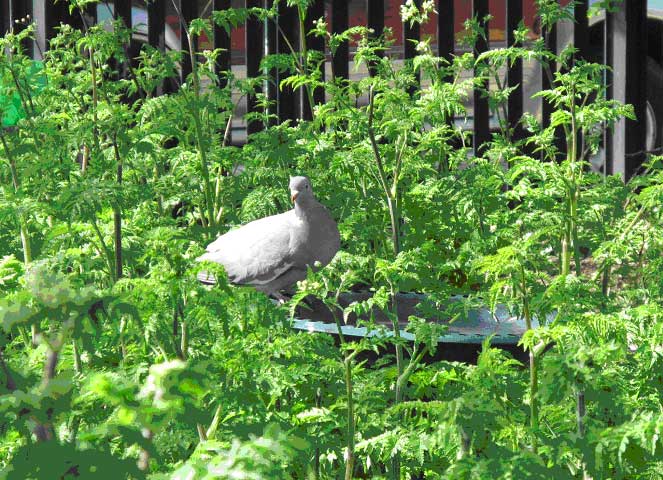
When I arrived, spring had just begun, the celandines were in bloom, the cow parsley was waist high and a wood-pigeon was having a sneaky bird-bath amidst the foliage that covered the wildlife spot next to Cable Street. This part of the gardens is given over to nature, and a garden volunteer turns up twice a day to keep the bird feeders full for the many different species that have discovered this soup-kitchen for birds. There are bats in the evening and tales of a parrot and a kestrel who once lived here too. And the bees – look out for a modern, green, plastic beehive on one of the plots and the story goes that the plot grower and bee keeper met her husband here, when he came to photograph the unusual-looking hive. That’s just one of the many ways in which these gardens have affected the lives of its growers for the better.

 The cow parsley was waist high and a wood-pigeon was having a sneaky bird-bath amidst the foliage.
The gardens started through a campaign by Friends of the Earth in 1977 to reclaim derelict land in the city. A few years later and the Cable Street Community Gardens Association had been formed. Its success has been such that it has spilled out from the two small strips behind tin fencing which were its origins to a 50-plot site traversing both sides of the Docklands Light Railway, with another 10 plots round the corner in Glamis Street. Relationships with the convent, church and schools have flourished, as have those with the council and bankers in Canary Wharf, who have helped with funding and support. Many a commuter’s journey home has been cheered by looking down on the space and finding a gardener or their children smiling and waving back at them. One gardener has kept the convent in rhubarb for many years and everyone talks of who they donate their produce to. When you see blackcurrant bushes growing as high as your head with strings of fruit forming, you know that this is a fertile and special place.

The vegetables represent different countries and continents – from Japan to India to Eastern Europe and the Caribbean. English cockneys dig side by side with new-found friends from many corners of the earth. All are Londoners. Money from the banks had just been spent on some new benches, beautifully engraved with the names of growers who have passed away, and a granddaughter of one had come to remember the good days of her childhood, when she helped her grandfather sow potatoes and ride the donkeys on the open days. He had been born in Cork (where there is another bench for him outside a betting office) and had worked on the Thames Barrier before he eventually found Cable Street and started his gardening career.

The open day for the gardens is now held on the Open Garden Squares Weekend and the organisers are trying to see if they can find any donkeys this year – but if they don’t manage to, they promise the most amazing food of bread, cakes and pastries (nothing shop-bought), a pottery sale and a local history tour, as well as a bric-à-brac sale.  The area oozes history – it’s not just confined to the Cable Street name – and you can drink in one of London’s oldest pubs, the Prospect of Whitby, after you have taken in the delights of the gardeners and their produce, and sampled the bit of inner-city magic they have made together. 

Information on visiting Cable Street Community Gardens »

Tuesday, 2 April 2013

Spot the Hobbit

My visit to the SHARE project was on one of the bitterest March days of our endless winter. A day when simply getting out and facing the cold took courage. And yet here were horticultural trainees happily braving the wind and weaving backwards and forwards across the gardens, sowing and tending new plants, for the Open Garden Squares weekend in June. The sweet peas were climbing their frame and lettuces and miniature daffodils were invitingly on sale.


SHARE is a community horticulture project for adults with learning difficulties and disabilities with approximately 30 trainees. It is a hidden surprise, beside a golf course in the grounds of Springfield Hospital, where 150 years ago male patients took their exercise in the Male Airing Court, and grew vegetables for the inmates, in a time when Springfield was the Surrey County Pauper Lunatic Asylum. The men grew vegetables in those days and were separated from the women, who took their exercise amongst flowers and herbaceous borders in another nearby space. Now both men and women work and train alongside and the flowers, herbs and vegetables are happy together as well.  

There are no inmates now from the hospital in the project, but there are strong links between the two organisations and the trainees maintain flower beds in the hospital grounds. Several trainees have developed their horticultural skills to the extent of achieving horticultural qualifications – the NVQ levels 1 and 2 in work-based horticulture and plant production are taught in the garden. Some have also found work outside in gardens. The project has developed extensive propagation facilities – there are two working polytunnels and a new, soon to be heated, large glasshouse. The trainees have a history of selling their produce locally to a neighbouring allotment (The Beatrix Potter allotment), and they also undertake a variety of external commercial work in Wandsworth and Roehampton. The fruits of their labours are also turned into delicious jams and pickles by their sister catering project in Battersea. This is definitely the place to come for buying jars of chutney and plants at bargain prices during the Open Garden Squares weekend of June 8th and 9th. Herbs, vegetables and annuals were already starting to sprout in anticipation when I visited.

The community links of SHARE are impressive. It’s a Capital Growth Project and modern training outfit with links on Facebook and Twitter. Nearby lies Streatham Cemetery, where the Friends of Streatham Cemetery have established five beehives. So SHARE are busy building raised beds, which will be planted up with bee-friendly plants for the bees to forage. And, as well as gardening, the trainees have been out and about to their local college, South Thames College, to raise awareness about disability.  

 SHARE Community Garden on a warmer day
Visitors to SHARE on the Sunday of Open Garden Squares Weekend will also have the opportunity to visit a couple of new gardens in the area, the Tooting Community Garden and the Streatham Common Community Garden at The Rookery.  SHARE are hoping to perhaps have a small exhibition too, maybe of art work, or the work of another local charity, so there should be plenty to do and see. There’s a living willow mosaic and a rose arbour, where you can sit and contemplate, or maybe settle in a seat by the pond. My top tip is to wander to the little hillock on the side of the garden, where the trainees have lovingly recreated a hobbit house. Needless to say, it was too cold when I visited to see the hobbit, who must have been tucked up inside by a warm coal fire.

Visiting SHARE Community Garden »

Friday, 1 March 2013

A Permanent Exhibit

When you put the words Garden and Tate Modern together, you conjure up images of beautiful but angular, minimalist spaces. Silver birch trees planted in rectangles, swaying in the wind next to crisp gravel paths or precise green lawns.  Beside this vista hides Tate Modern's Community Garden, secluded behind a galvanised steel grid, across which ivy has been grown. The observant passer-by will spot the windows in the ivy and inside the contrast reveals itself, for the Community Garden is round and curvy, with angularity confined to the rectangular plots on which the garden was built.

Hugging a side space on the Thames side of Tate Modern, near the Millennium Bridge, the garden was started in 2004 and opened to local residents living within walking distance in 2007.  It's a collaborative venture between the Bankside Open Spaces Trust and the gallery.  When Tate Modern was built in the enormous power station by the river, the lives of residents, Southwark and indeed London changed forever, for it turned out to be the front runner of a plethora of cultural regeneration projects along the south side of the river. Residents had to live with the enormous disruption of year-on-year major building projects; so the commitment of Tate Modern to community involvement and the emergence of the Bankside Open Spaces Trust were welcome indeed. Now, although many of the new riverside apartments may sell for astronomical sums, gardens are not a common feature, so this communal garden serves its purpose well, as evidenced by the fact that it has over 700 people registered as friends and an average of 300 visits per month.


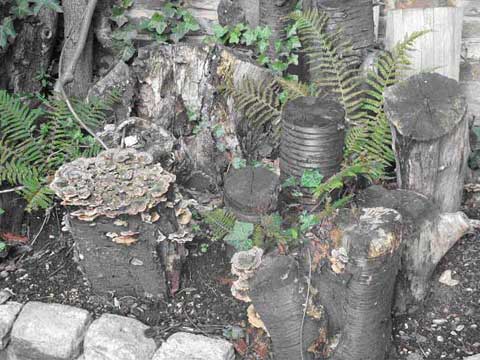
With additional external funding from the Metropolitan Parks and Gardens Association, the garden's curved spaces and pond have been planted with over 100 different species, reflecting a mixture of indigenous and Mediterranean climates and designed in a muted colour scheme. When I visited for the Open Garden Squares Weekend, it was a glorious winter's day - bitingly cold but with the odd waft of warmth from a clear blue sky. A volunteer was digging over the soil hardened by snow and frost to reveal hellebores. Three varieties of hellebore have been planted- Helleborus niger, Helleborus argutifolius and Helleborus orientalis - but it was the simple Helleborus niger which stole the show and my heart.  By June, when the garden opens to the public, the hellebores and bulbs will have disappeared, but the Mediterranean plants, the pond, the rose pergola and the ferns nestling amongst logs will take over to delight you. Fruit bushes and herbs will also be budding and scenting the air.  Pond life should be thriving – this one is home to newts, frogs, dragon and damsel flies.  There used to be over 100 goldfish, but a heron flew by and gobbled them all up on one visit!  Nonetheless, despite the heron, this continues to be a favourite spot for pond dipping for local schoolchildren. 


The garden started out as a wildflower garden in 2007.  The soil was rubble from the building work and the flowers loved the poor conditions. Beautiful though they were, the garden was too small a space to limit itself to the short flowering season of wildflowers and gradually the mixed planting was introduced, along with a lot of compost and tender loving care.

The garden contains some beautiful seating, and wooden features, all designed and built by Arthur De Mowbray, who specialises in garden structures for the public arena.  The shelter near the entrance is particularly striking.  From it you can look out across the length of the garden.  Beautiful places to sit, look and contemplate are important.   The litter bins are also bespoke – with wooden shells as lids.  And the courtyard walls are adorned with round plates of art – produced by older local people using concrete and objects found on the nearby river shore.


The Community Garden is definitely worth a visit.  Afterwards, you can pop into the gallery, where there’s a café and shop and, of course, lots of modern art.  Not that the garden isn’t also art – this is Tate Modern’s permanent exhibit.

Information on visiting the Community Garden at Tate Modern

See how it looks in the summer

Sunday, 3 February 2013

An Eccentric’s Delight

The volunteers at the Roe Green Walled Garden describe themselves as eccentrics, and they typify the very best of English eccentricity. A recreated, life-sized figure of a gardener from the 1901 census greets visitors as they arrive, to remind them of the late-Victorian heritage of the original walled garden built for the Duchess of Sutherland in 1899.

Even the Duchess of Sutherland has been recreated in life-size form and she sits proudly in the bric-à-brac shed, which is the hidden life-blood of the garden. Volunteers don’t just garden here: they rummage in skips and have become expert in recycling scrap metal and selling anything they can to maintain a good income stream for their lovely garden.

The garden is designed around children – not only does a teddy bears' picnic area occupy part of the lawn, but there is an active kids' newt club, which looks after the great crested newts in the wildlife pond – and the local mayor even visited to open the insect hotel the children built. A yew has been clipped into the shape of a dog and throughout there’s lots to keep children amused and interested in wildlife and gardening.

The garden started when volunteers started to take over maintenance of the nearby Fryent Country Park. At first they stored their tools at home, then a shed was given to them on the site of the old walled garden and then they recreated the garden from the rubble of the old one. Now they proudly display their gardening awards – in 2012 the Royal Horticultural Society (RHS) declared the garden ‘outstanding’ in the ‘It's Your Neighbourhood’ category, and they also hold the Green Flag Community Award for biodiversity. The rose pergola which leads to the first of their two ponds has been rebuilt and replanted, alongside a Devon bank, a rockery, a dry-stone wall and fern garden. Along the length of the plot lies the long herbaceous border, a glorious display of colour in summer.

Small vegetable plots with Welsh onions and espalier apple trees line another side of the garden. Volunteers garden the plots together and share the produce. Compost is made in abundance and the gardeners continually seek out innovation – recently having successfully grafted mistletoe onto an old apple tree. A new ‘Core Blimey’ apple tree has just been planted – specially promoted by the London Orchard Project for its resistance and suitability for cities.

The garden is host to a rain measurement centre for the Environment Agency and, buoyed on by this, they are now monitoring the weather in other ways as well for their own recreation. A beehive has been started, log piles are strategically placed to attract insects, they’ve created a home for three or four hedgehogs, mute swans have visited and bats have been spotted in the nearby country park.

Visiting the garden next June is highly recommended. There will be hot food, vegetarian curry being a house special, as well as sandwiches and cakes, lots of children’s activities, bric-à-brac and plant sales. A beautiful, peaceful place with lots to keep the whole family interested – don’t miss it.