Friday, 1 March 2013

A Permanent Exhibit

When you put the words Garden and Tate Modern together, you conjure up images of beautiful but angular, minimalist spaces. Silver birch trees planted in rectangles, swaying in the wind next to crisp gravel paths or precise green lawns.  Beside this vista hides Tate Modern's Community Garden, secluded behind a galvanised steel grid, across which ivy has been grown. The observant passer-by will spot the windows in the ivy and inside the contrast reveals itself, for the Community Garden is round and curvy, with angularity confined to the rectangular plots on which the garden was built.

Hugging a side space on the Thames side of Tate Modern, near the Millennium Bridge, the garden was started in 2004 and opened to local residents living within walking distance in 2007.  It's a collaborative venture between the Bankside Open Spaces Trust and the gallery.  When Tate Modern was built in the enormous power station by the river, the lives of residents, Southwark and indeed London changed forever, for it turned out to be the front runner of a plethora of cultural regeneration projects along the south side of the river. Residents had to live with the enormous disruption of year-on-year major building projects; so the commitment of Tate Modern to community involvement and the emergence of the Bankside Open Spaces Trust were welcome indeed. Now, although many of the new riverside apartments may sell for astronomical sums, gardens are not a common feature, so this communal garden serves its purpose well, as evidenced by the fact that it has over 700 people registered as friends and an average of 300 visits per month.


With additional external funding from the Metropolitan Parks and Gardens Association, the garden's curved spaces and pond have been planted with over 100 different species, reflecting a mixture of indigenous and Mediterranean climates and designed in a muted colour scheme. When I visited for the Open Garden Squares Weekend, it was a glorious winter's day - bitingly cold but with the odd waft of warmth from a clear blue sky. A volunteer was digging over the soil hardened by snow and frost to reveal hellebores. Three varieties of hellebore have been planted- Helleborus niger, Helleborus argutifolius and Helleborus orientalis - but it was the simple Helleborus niger which stole the show and my heart.  By June, when the garden opens to the public, the hellebores and bulbs will have disappeared, but the Mediterranean plants, the pond, the rose pergola and the ferns nestling amongst logs will take over to delight you. Fruit bushes and herbs will also be budding and scenting the air.  Pond life should be thriving – this one is home to newts, frogs, dragon and damsel flies.  There used to be over 100 goldfish, but a heron flew by and gobbled them all up on one visit!  Nonetheless, despite the heron, this continues to be a favourite spot for pond dipping for local schoolchildren. 
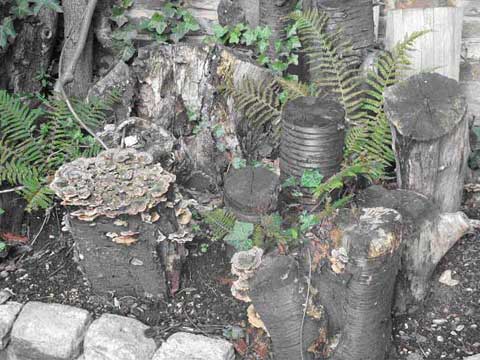


The garden started out as a wildflower garden in 2007.  The soil was rubble from the building work and the flowers loved the poor conditions. Beautiful though they were, the garden was too small a space to limit itself to the short flowering season of wildflowers and gradually the mixed planting was introduced, along with a lot of compost and tender loving care.

The garden contains some beautiful seating, and wooden features, all designed and built by Arthur De Mowbray, who specialises in garden structures for the public arena.  The shelter near the entrance is particularly striking.  From it you can look out across the length of the garden.  Beautiful places to sit, look and contemplate are important.   The litter bins are also bespoke – with wooden shells as lids.  And the courtyard walls are adorned with round plates of art – produced by older local people using concrete and objects found on the nearby river shore.


The Community Garden is definitely worth a visit.  Afterwards, you can pop into the gallery, where there’s a café and shop and, of course, lots of modern art.  Not that the garden isn’t also art – this is Tate Modern’s permanent exhibit.

Information on visiting the Community Garden at Tate Modern

See how it looks in the summer

Sunday, 3 February 2013

An Eccentric’s Delight

The volunteers at the Roe Green Walled Garden describe themselves as eccentrics, and they typify the very best of English eccentricity. A recreated, life-sized figure of a gardener from the 1901 census greets visitors as they arrive, to remind them of the late-Victorian heritage of the original walled garden built for the Duchess of Sutherland in 1899.

Even the Duchess of Sutherland has been recreated in life-size form and she sits proudly in the bric-à-brac shed, which is the hidden life-blood of the garden. Volunteers don’t just garden here: they rummage in skips and have become expert in recycling scrap metal and selling anything they can to maintain a good income stream for their lovely garden.

The garden is designed around children – not only does a teddy bears' picnic area occupy part of the lawn, but there is an active kids' newt club, which looks after the great crested newts in the wildlife pond – and the local mayor even visited to open the insect hotel the children built. A yew has been clipped into the shape of a dog and throughout there’s lots to keep children amused and interested in wildlife and gardening.

The garden started when volunteers started to take over maintenance of the nearby Fryent Country Park. At first they stored their tools at home, then a shed was given to them on the site of the old walled garden and then they recreated the garden from the rubble of the old one. Now they proudly display their gardening awards – in 2012 the Royal Horticultural Society (RHS) declared the garden ‘outstanding’ in the ‘It's Your Neighbourhood’ category, and they also hold the Green Flag Community Award for biodiversity. The rose pergola which leads to the first of their two ponds has been rebuilt and replanted, alongside a Devon bank, a rockery, a dry-stone wall and fern garden. Along the length of the plot lies the long herbaceous border, a glorious display of colour in summer.

Small vegetable plots with Welsh onions and espalier apple trees line another side of the garden. Volunteers garden the plots together and share the produce. Compost is made in abundance and the gardeners continually seek out innovation – recently having successfully grafted mistletoe onto an old apple tree. A new ‘Core Blimey’ apple tree has just been planted – specially promoted by the London Orchard Project for its resistance and suitability for cities.

The garden is host to a rain measurement centre for the Environment Agency and, buoyed on by this, they are now monitoring the weather in other ways as well for their own recreation. A beehive has been started, log piles are strategically placed to attract insects, they’ve created a home for three or four hedgehogs, mute swans have visited and bats have been spotted in the nearby country park.

Visiting the garden next June is highly recommended. There will be hot food, vegetarian curry being a house special, as well as sandwiches and cakes, lots of children’s activities, bric-à-brac and plant sales. A beautiful, peaceful place with lots to keep the whole family interested – don’t miss it.

Tuesday, 1 January 2013

Growing food amongst the rubble

You may have marvelled at the new St Pancras and King's Cross stations, and stared in disbelief at the transformation taking place in this area of London. But did you know that, whilst these new massive structures were being created, amongst the rubble of the old, a community garden was busy growing food from skips, with a little help from the local builders?


The Skip Garden was started in 2004 by Global Generation with the initial aim of taking kids to the country. They then decided to bring the country to the city at King's Cross and the garden has moved its skips and makeshift structures several times as the buildings around it have been completed. The garden has strong links with the building companies in the area and uses recycled materials from the King's Cross reconstruction site. Even the skips are disused ones and have been adapted to create walk-in gardens. Amongst an array of plants and activity, there’s a potager skip and an orchard skip, each with very close plantings, but very healthy plants, all due to the care spent on recycling. A cunning water recycling scheme links all the skips and planters and is supplemented by a wormery, composting and comfrey juice extraction to ensure that the soil is the very best – as it needs to be in this environment. The aim is to show that food can be grown anywhere – and it succeeds. For keen urban gardeners, there are lots of lessons and tips to be gained on how to grow vegetables organically, using the resources you find around you.

Growing vegetables is used for educational purposes with young people, known as generators, recruited to help. They now sell produce to the many trendy restaurants which have sprung up in the area and have a makeshift kitchen where they host lunch and learning events every two months for the local community and produce jam and chutney for sale. The students from Central St Martin's have got involved, so now vegetables are also being grown to use as dyes. The fabric and materials they have helped create will also be on display.


It is the sight of fruit trees flourishing in skips and saffron harvested from a bed of crocuses which inspires the visitor. Bat boxes have been constructed amongst the vegetables and the wild, overrun banks of rubble nearby have been planted with bee-friendly plants.

The Skip Garden is not usually open to the public, but over Open Garden Squares Weekend on June 8th and 9th you can visit it and for the first time sample the delights of its kitchen as well as its garden. Paul and Silvia and the generators will organise a tour of the skips, the recently constructed yurt, the clay pizza ovens and the chance will be yours to see at first hand how vegetables and herbs of all kinds can be produced in such small spaces.

Who would have thought such a garden existed behind the cranes which dominate the King's Cross skyline? And when your visit is over, there are several other gardens to visit nearby, and the chance to sample the delights of this newly-recreated area of London.

Saturday, 22 December 2012

In the Shadow of the Great and Good

You may know Kensington's Holland Park. You may have visited the Dutch Garden and the Japanese Garden. You may even have attended an opera - with peacock accompaniment. But you have probably not visited the secret garden that takes part in Open Garden Squares Weekend and where you can gain the best idea of the original architecture of Holland House.

A Distinguished History


The original house was built in 1607 for Sir Walter Cope, James I’s Chancellor, whose heiress married Sir Henry Rich, later Earl of Holland. Rich built the magnificent stables (since largely rebuilt, with a splendid modern sequence of murals depicting a garden party held in the 1870s by the then Earl of Ilchester) and the coach house, west of Holland House, beyond which is the Dutch Garden with its intricate beds of triangles and rectangles. The back wall now forms part of the Belvedere restaurant, and past the toddlers ’play area is the Orangery and the rose garden.

In front of the line of brick arches, formerly part of the old stable block, now a hard surfaces area with benches, was where the 3rd Lady Holland raised some of the first dahlias to be grown in England, in the early 1800s.

By 1860, when the 4th and last Lord Holland died, his widow came into increasing financial difficulties and Holland Park only now survives because in 1874 Henry Edward Fox-Strangways, 5th Earl of Ilchester and a descendant of the 1st Lord Holland, agreed to take the mortgaged estate in return for allowing the dowager Duchess to live at Holland House for the rest of her life. The 5th Earl added a water and rock garden in the 1890s and a Japanese garden (to the north of the Dutch garden), which, fifty years after the WW2 bombing, was re-created with Anglo-Japanese funding.

An Admirable Present


During WW2 the house was bombed and destroyed by fire. Afterwards the remains of one wing were repaired. With new buildings designed by Sir Hugh Casson and Neville Condor, this now forms the King George VI Memorial Youth Hostel, officially opened by HM the Queen in 1959. With 10 rooms and 200 beds, it serves 50,000 hostellers a year, mainly in groups.

The Gardens


The public gardens, including the Dutch Garden and the Japanese Garden, lie mainly to the west of the house, though they extend south of the surviving garden front, with the famous Inigo Jones gates.

The special part of the garden, which takes part in Open Garden Squares Weekend, lies within the grounds of the youth hostel on the east side and is normally only visible through the perimeter gates. From here you can gain the best idea of the original architecture of Holland House, with its arcading and Dutch gables. There is a large well-stocked pond, visited by mallards, moorhens, herons and peacocks.

Open Garden Squares Weekend


Holland House Garden will be open to Open Garden Squares Weekend visitors on Sunday 9th June 2013 from 10am to 5pm. Tea and coffee will be available - and a barbecue if the weather permits.

The garden is a convenient one to visit between gardens to the south of Kensington, such as Edwardes Square, and those to the north, such as Ladbroke Square.

Further Reading

Friday, 25 May 2012

Surviving and thriving in the heart of the West End

The Phoenix Garden has to be one of the most aptly named of all the gardens Duck Island Cottage has explored for this year’s Open Garden Squares Weekend. It was created in 1984 by a group of local volunteers from a space which was acting as a car park. It is a remarkable example of what can be achieved with about six inches of topsoil below which sits a bedrock of rubble. The Phoenix Garden is the only surviving garden from an original group of seven community gardens in the Covent Garden area; the other six were lost to development. However, given the involvement of the London Borough of Camden, Phoenix’s future is safe and secured, with a much-needed new garden building planned for 2012.


The Phoenix Garden is overlooked by the 18th-century spire of St Giles-in-the-Fields parish church.
Tucked away behind Shaftesbury Avenue, and overlooked by the 18th-century spire of St Giles-in-the-Fields parish church, the garden today bears very few traces of its colourful history – there was a leper hospital on the site in the early 12th century and the images in Hogarth’s infamous Gin Lane of 1751 were inspired by contemporary scenes and characters from the area.


In the company of its gardener, Chris Raeburn, and Jane Palm-Gold, from the garden’s management committee, Duck Island spent two hours exploring the garden’s plants, trees and gently sloping walkways, with many seats created using stones saved from the previous site. Since 2002, Chris has worked a running programme to re-landscape and re-plant, in what previously had become an overgrown, unruly space. His planting features both wild and cultivated specimens, and the effect is of an ordered but thoroughly natural garden. The beds here are made up of dense, supporting layers, wonderful to look at and fantastic environments for insects and birds. In Chris’s own words, plants will grow in any location if they are suited to the site. Given the land’s relatively recent usage, scrubland weeds are key to underpinning the garden’s micro-ecology and certain beds have never been dug by Chris. As he says, if you constantly dig the soil, vigorous colonising plants will try to take over and the garden does not need the kind of tending required by an allotment. He favours long-flowering ornamentals so that the garden has colour and scent all year round.

London’s corporations and companies tend to favour formal, neat designs for their gardens, and a generous annual budget is key to maintaining this look. However, Chris’s first yearly plant allowance was £40 and, although it has grown a little since, it is a still a fraction of what can be spent on a garden, along with chemical fertilisers and herbicides. As a result, The Phoenix Garden features a diverse range of plants and wildlife and so genuinely provides an easy access to nature.

We look forward to seeing The Phoenix Garden in all its glory this June, and we know you’ll be captivated and intrigued by this inspirational space.

Information on visiting The Phoenix Garden »

Tuesday, 24 April 2012

An urban oasis for wildlife and people

This month Duck Island Cottage visited Camley Street Natural Park - a short walk from Euston Road, located within the heart of the King's Cross redevelopment and in a part of London with very little open space.

Many of Open Garden Squares Weekend’s participating gardens are centuries-old squares and dedicated green spaces. But, this park in its current incarnation is a youngster, having just passed its quarter-century.

From 1870, the bijou two-acre site was used for coal storage and in the 1950s, as the demand for coal diminished, the area became derelict. The land was purchased by the former Greater London Council in 1981 with the intention of creating a coach park. However, in the intervening years a remarkable array of wild plants had colonised the land - an amazing development given the shallow topsoil, below which, just five inches down, lay rubble and toxic remnants left over from the area’s previous use. It was agreed to turn this resilient, unique site into a park and so landscaping commenced in 1983, followed by tree planting in 1984.

Skilled, thoughtful landscaping and planting makes the park feel spacious: it packs in meadows, marsh woodlands and an open water habitat - fed by the waters of the Regent's Canal.


Pond-dipping is one of the most popular activities for schoolchildren visitors
(Photo: Sarah Jackson)
Now managed by the London Wildlife Trust, the Park’s focus is on the management and maintenance of diverse wildlife, which includes a wide variety of birds, bees and butterflies, amphibians and plants. And it also provides the local community with a valuable resource, providing environmental education for schools and opportunities for volunteers to get involved in tending and managing the site.

One of the Park’s wood-chipped walkways bordered by dense and lush foliage
(Photo: Sarah Jackson)
The Park continues to evolve and develop. The latest projects are the creation of a floating forest garden in a restored grain barge moored nearby and the construction of two clay, wood-fired ovens which form the centrepiece of an outdoor cooking and dining area, which itself is bordered by a backdrop of reclaimed logs. 

Camley Street Natural Park is a wonderful example of nature’s ability to survive and thrive in the most challenging of conditions. Please add it to your gardens itinerary this June!

Friday, 9 March 2012

Octavia Hill’s 'vision for society'

This month, Duck Island Cottage has been absorbed and fascinated by the life and work of Octavia Hill (1838-1912). Red Cross Garden, near Borough High Street, bears testimony to her campaigns and causes. On the long list of her achievements is co-founding the National Trust, (with Sir Robert Hunter and Canon Hardwicke Rawnsley), in 1895. Octavia was concerned by the impact of uncontrolled development and industrialisation; and the Trust was set up to act as guardian for the nation in the acquisition and protection of threatened coastline, buildings and countryside. 100 years on from Octavia’s death, it’s highly appropriate that in 2012 Open Garden Squares Weekend is being held in association with the National Trust. It’s also a great opportunity to re-consider the work of this campaigner for open spaces, par excellence.

Octavia Hill’s blue plaque on Bishop’s Hall overlooks her Red Cross Garden
(photo: Lucinda Blythe)
The first thing that strikes one is the scale of the garden. In the gloom of the densely packed streets of 19th-century Southwark, this would have been a spacious, green oasis, but it’s truly compact. Duck Island Cottage wonders what the residents of the 1880s would have made of the Shard, the garden’s towering neighbour, and the soaring heights of the City skyline just over the river.

Red Cross Garden is one element, along with Bishop’s Hall and six cottages (on the same site), in what is considered to be one of Octavia Hill’s finest environmental and social schemes. The Garden was laid out in 1887 and, along with paths, flowers, trees and a pond and a bandstand, it hosted the annual Southwark Flower Show, as well as numerous fetes and celebrations, including maypole dancing. The Hall likewise bustled with activities: it was the venue for working men’s clubs, women’s groups, concerts and plays, and the Army Cadets – the movement was founded here by Octavia. The cottages border the eastern flank of the garden, and provided an alternative to the cramped tenement buildings, which, at the time, stood across the road. 
The Cottages with their view of Red Cross Garden
(photo: Lucinda Blythe)
The original garden layout was lost to a simplistic design after World War II, but a restoration programme, with Heritage Lottery Fund and Southwark council backing, commenced in 1997 and was completed in 2005. The new design is true to the original, but is also a delightful community space. In a nod to Octavia’s own principles, recycled materials were used and the pond, originally designed only for fish, was excavated and is now both ornamental and a haven for wildlife.

Red Cross Garden is as relevant today as when created by Octavia Hill. Duck Island Cottage urges you to add it to your itinerary this June.
A mosaic with designs based on local schoolchildrens’ sketches created for the new garden
(photo: Lucinda Blythe)